


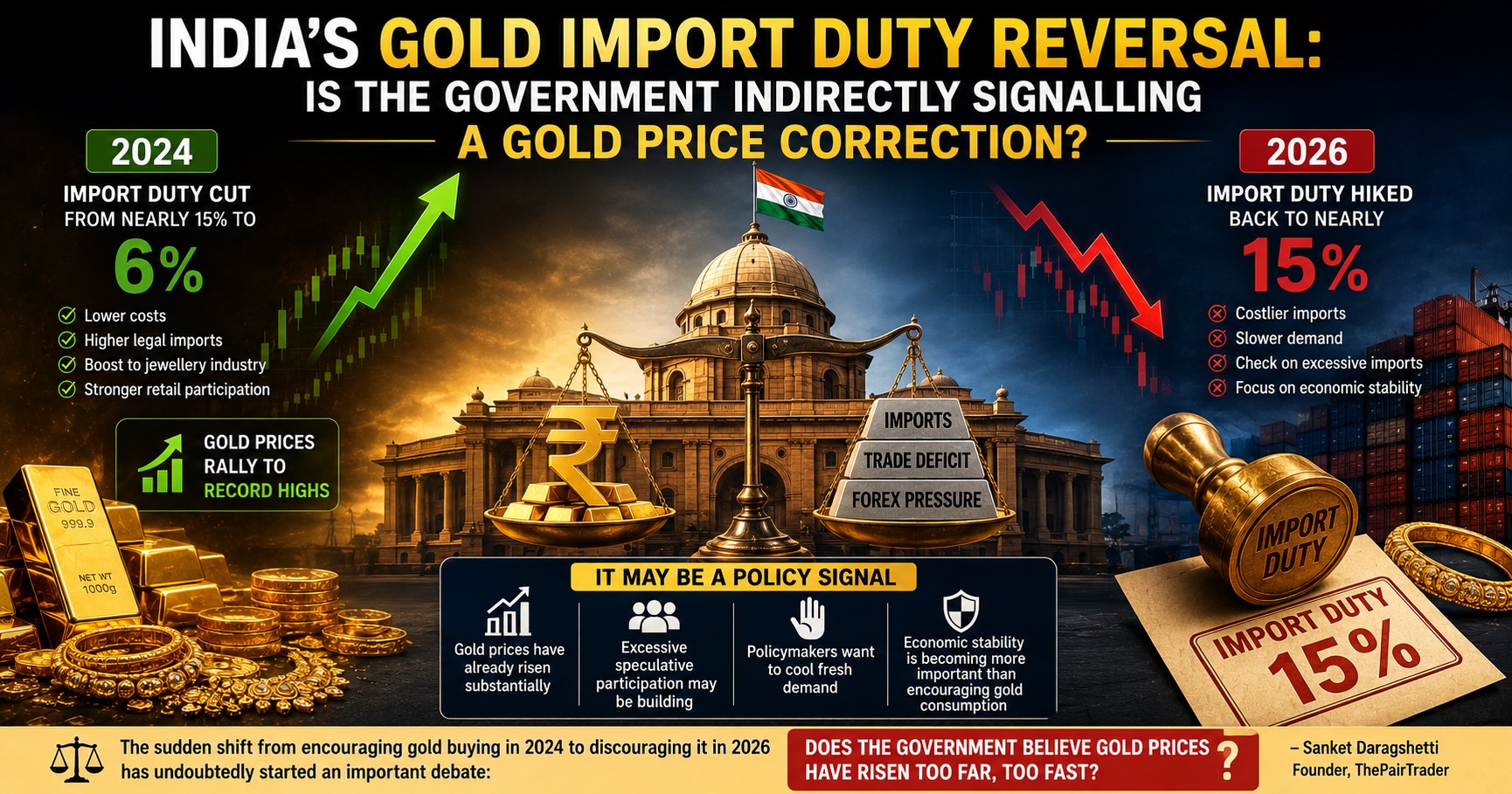
India’s gold import duty history reveals a very clear pattern — whenever gold demand rises aggressively and starts impacting the economy, the government eventually intervenes through policy changes.
The latest decision to increase gold import duty back to nearly 15% has once again triggered an important debate across financial markets:
Is the government indirectly signalling discomfort with the sharp rise in gold prices?
1. India Has Historically Used Gold Import Duty as an Economic Control Too
Gold import duty in India has never been just about taxation. It has consistently been used as a macroeconomic balancing mechanism to manage imports, protect forex reserves, stabilize the rupee, and control the current account deficit.
Before 2012, import duty on gold was relatively low at around 2% because gold held deep cultural and economic importance in Indian households.
However, rising gold demand led to massive imports, putting pressure on India’s forex reserves and widening the current account deficit.
During the 2012–2013 economic stress period, the government sharply increased import duty in multiple phases:
- 2% → 4%
- 4% → 6%
- 6% → 8%
- Eventually reaching 10% by 2013
This period also saw restrictions on gold imports, the famous “80:20 rule,” and a sharp rise in gold smuggling.
Later, in 2019, customs duty was increased again from 10% to 12.5% to generate revenue and control non-essential imports.
In 2021, duty was slightly reduced to around 10.75% to reduce smuggling and support the jewellery industry.
2. The 2024 Duty Cut Coincided With a Massive Gold Rally
In 2024, when gold prices in India were trading below ₹70,000 per 10 grams, the government made a surprising move by sharply reducing import duty from nearly 15% to 6%.
The decision reduced the cost of importing gold, encouraged legal imports, supported the jewellery sector, and boosted retail participation.
Soon after, gold prices witnessed a historic rally.
Strong global uncertainty, geopolitical tensions, central bank buying, investor fear, rupee weakness, and rising domestic participation pushed gold prices to record highs.
The lower import duty further added fuel to the rally by making gold relatively cheaper for Indian buyers during a crucial phase of the move.
3. The Sudden Reversal in 2026 Raises Bigger Questions
Now, less than two years later, the government has completely reversed its stance and increased import duty back to nearly 15%.
Officially, the reasons remain macroeconomic:
- Controlling imports
- Protecting forex reserves
- Stabilizing the rupee
- Managing the current account deficit
However, the timing of the decision is what makes the market curious.
Historically, aggressive duty hikes are usually implemented when policymakers become uncomfortable with excessive imports, speculative activity, or rapidly rising demand.
Higher import duty naturally discourages fresh buying because imported gold becomes more expensive domestically.
This is why many market participants believe the latest move may also be an indirect signal aimed at cooling demand.
4. The SGB Angle Makes the Decision Even More Interesting
One of the most interesting aspects of the latest duty hike is its indirect impact on Sovereign Gold Bonds (SGBs) and domestic gold pricing.
Since Indian gold prices are influenced by import costs, higher duties can technically support domestic gold valuations.
This means existing gold holders and SGB investors may benefit on paper from elevated local gold prices.
However, there is another side to this.
Higher domestic gold prices also increase the government’s liability towards Sovereign Gold Bond payouts because SGB returns are linked to prevailing gold prices.
In simple terms, what becomes a gain for SGB investors can also become a higher payout obligation for the government.
Yet despite this possibility of increased liabilities, the government has still chosen to sharply increase import duties.
This suggests that the concern may no longer be about supporting gold prices, but about slowing the pace of money flowing into gold itself.
5. Is This a Policy Signal on Gold Prices?
Gold imports put pressure on India’s forex reserves, widen the trade deficit, and can weaken the rupee.
From a broader macroeconomic perspective, policymakers may also worry when excessive household savings move into gold instead of productive financial assets.
This is why the latest duty hike appears larger than just a taxation decision.
It increasingly looks like a policy signal.
The message could be interpreted as:
- Gold prices have already risen substantially
- Speculative participation may be increasing rapidly
- Policymakers want to cool fresh demand
- Economic stability is becoming more important than encouraging gold consumption
Of course, no government officially predicts future gold prices.
However, history shows that sharp policy reversals often reflect growing discomfort with the speed and scale of a market move.
Whether this eventually leads to a major correction, a prolonged consolidation phase, or simply a slowdown in fresh demand remains uncertain.
But the sudden shift from encouraging gold buying in 2024 to discouraging it in 2026 has undoubtedly started an important debate:
Does the Government Believe Gold Prices Have Risen Too Far, Too Fast?
— Sanket Daragshetti
Founder, ThePairTrader
