



Indian Market – Correction or Opportunity?
The Indian equity market has been going through a sustained correction since early August. The Nifty has now recorded 8 consecutive weeks of decline — its longest weekly losing streak in 25 years — and is down approximately 9.5% from the peak made on 3 August, the day CAS was introduced. The correction intensified further following the release of India’s latest GDP report.
Naturally, a fall of this magnitude has created considerable nervousness among investors. Television, social media and market discussions are increasingly dominated by negative commentary, with one of the most common narratives being that FIIs are leaving India because of higher taxation on equity markets.
Taxation is certainly one of the concerns, and policymakers need to remain mindful that a healthy and vibrant capital market requires a supportive environment for both domestic and foreign investors.
But is taxation really the only reason the Indian market is falling?
I don’t think so.
The current correction needs to be viewed in a much broader context. Understanding the below factors is important because there is a big difference between a market falling because of temporary macroeconomic pressures and India’s long-term growth story fundamentally breaking down.
1. Crude Oil Above $100
India imports a significant portion of its energy requirements. Therefore, a sharp rise in crude oil prices has a much wider impact on India than simply making petrol and diesel expensive.
Higher crude increases India’s import bill, creates inflationary pressure, puts pressure on the rupee and can increase costs for several industries. Higher input costs can eventually affect corporate margins as well.
Therefore, rising crude oil is an important headwind for the Indian economy and equity markets.
2. US Bond Yields Above 5%
This is another important factor behind global capital flows.
When US government bonds offer yields above 5%, global investors have an attractive alternative available in one of the world’s deepest and relatively safest financial markets.
An investor then has to ask: Why take significantly higher equity and emerging-market risk unless the expected return justifies it?
As US bond yields rise, some global money naturally moves away from riskier assets and emerging markets. India is not alone in experiencing this phenomenon.
3. FII Selling and Pressure on the Rupee
Higher US yields, elevated crude prices and global risk aversion have contributed to foreign institutional investors reducing exposure to Indian equities.
FII selling itself creates additional pressure on the market.
At the same time, when foreign capital leaves and India’s import bill rises because of expensive crude, the rupee can also come under pressure. For a foreign investor, currency movement is another important component of the overall return from investing in India.
This creates a cycle where global risk aversion → FII selling → currency pressure → weaker market sentiment can reinforce each other for some time.
4. Weak Monsoon
Rainfall has been around 87% of normal, creating another concern for the economy.
The monsoon remains important for agricultural income, rural consumption, food inflation and demand across several sectors.
A weaker monsoon does not mean the economy suddenly stops growing, but it introduces another uncertainty at a time when markets are already dealing with high crude prices and difficult global liquidity conditions.
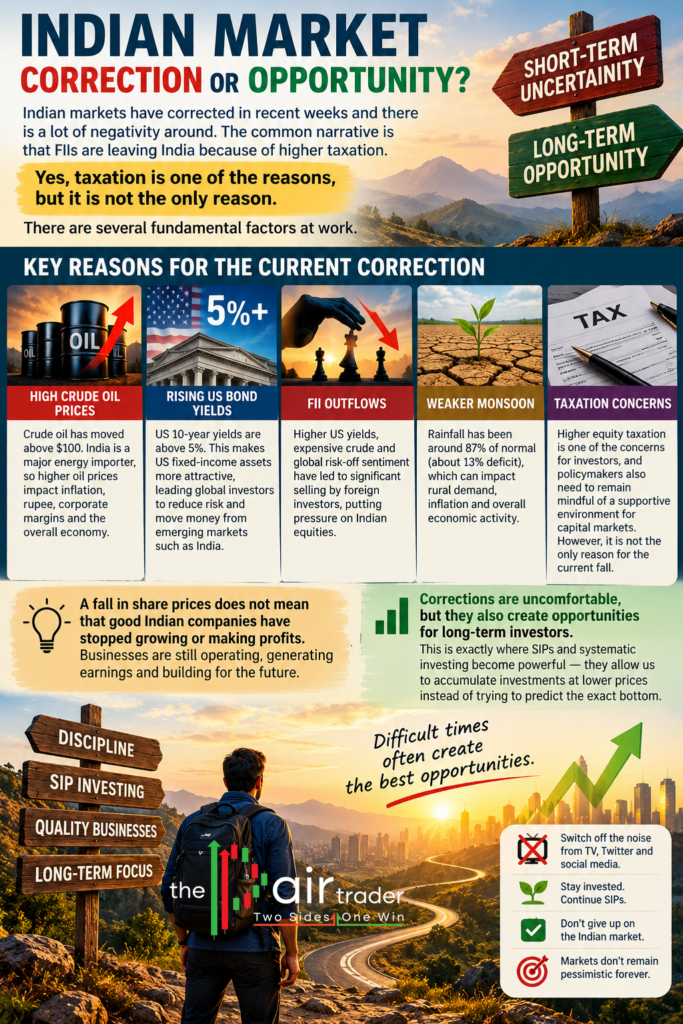
So, Is Taxation Responsible?
Partly, perhaps. But it would be an oversimplification to blame the entire correction on taxation.
The market is dealing with a combination of:
Higher taxation concerns + expensive crude oil + high US bond yields + FII selling + rupee pressure + weaker monsoon conditions.
When several negative factors arrive together, markets can correct much more sharply than any single factor would normally justify.
And this brings us to the most important point.
The Market Is Falling. Does That Mean India Has Stopped Growing?
No.
A falling share price does not automatically mean that a good company has stopped selling products, generating revenues, earning profits or expanding its business.
There is an important difference between the price of a business in the stock market and the underlying performance of that business.
During periods of fear, liquidity problems or global uncertainty, even fundamentally strong companies can see their share prices decline.
And that is precisely why market corrections eventually create opportunities.
When markets are rising every day, everyone wants to invest. Ironically, when valuations become more attractive during corrections, fear prevents many investors from investing.
This Is Where SIPs Become Powerful
For long-term investors, the objective should not be to predict the exact market bottom.
Nobody consistently knows whether the bottom is today, next week or three months from now.
Systematic investing allows us to keep accumulating through different market conditions. When markets fall, the same SIP amount purchases more units. When markets eventually recover, those accumulated units participate in the recovery.
That doesn’t mean blindly buying everything that has fallen.
Quality, asset allocation, diversification and valuation still matter.
Reduce the Noise
During corrections, television debates, Twitter/X, WhatsApp and social media naturally become dominated by negative headlines.
Every decline gets a new explanation. Every day someone predicts another crash.
But investment decisions should be based on business fundamentals, valuations, asset allocation and investment horizon — not on the loudest headline of the day.
Perhaps this is the time to switch off some of that noise and concentrate on what actually matters.
Crude oil will not remain at the same level forever. Interest-rate cycles change. Bond yields move. FII flows reverse. Currency pressures ease. Monsoons change.
And when some of these factors eventually turn favourable, the same forces hurting Indian equities today can become powerful triggers for the next market recovery.
Correction or Opportunity?
Probably both.
In the short term, corrections are painful and test investor patience.
But for investors with a sufficiently long horizon, strong businesses and a disciplined investment approach, difficult markets can also create some of the best opportunities.
Stay disciplined. Continue systematic investments. Focus on quality. Avoid reacting to every headline.
Most importantly:
Don’t give up on the Indian market because of short-term negativity.
The market may be falling today. India’s long-term growth story isn’t over.
Difficult markets test patience. They also create opportunities.
-Sanket Daragsehtti, Founder, ThePairTrader
