


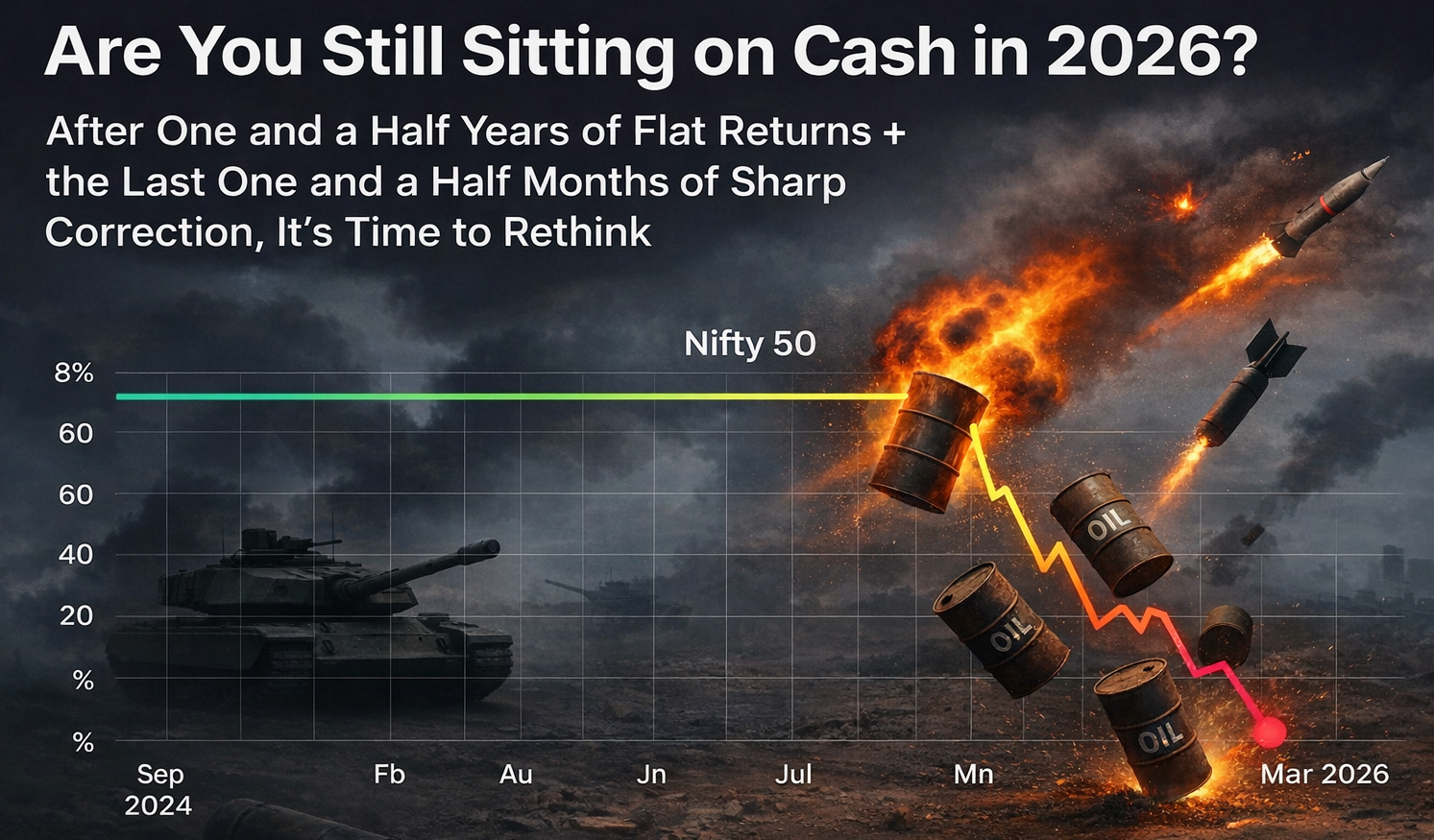
After 1.5 Years of Flat Returns + the 1.5 Months of Sharp Correction — It’s Time to Rethink
For many investors, the last one and a half years have been frustrating.
Between September 2024 and February 2026, the Nifty 50 gave almost no returns. It made new highs several times, but those highs did not last. As a result, many investors saw little progress in their portfolios.
Then things changed quickly.
In just the last one and a half months, the market corrected sharply. Since early February 2026, the Nifty has fallen nearly 10%, dropping from the 25,500–25,800 range to around 23,867 (as of March 11, 2026). Rising oil prices and geopolitical tensions in West Asia have added to the pressure on markets.
Interestingly, many investors were waiting for a correction like this to invest their cash. But now that the correction has happened, fear has increased and many people are still holding on to cash.
This raises an important question:
Is the bigger risk another small market fall — or missing the next market rally by staying out of the market too long?
Cash Is Not Always Safe
Keeping money in cash or fixed deposits may feel safe, but over time it also has a cost.
Inflation slowly reduces the purchasing power of money. In many cases, fixed deposit returns are close to or sometimes even below inflation. This means that money sitting idle may slowly lose its real value.
At the same time, the economy keeps growing. India continues to see growth in consumption, infrastructure spending, and corporate earnings. Over long periods, equity markets tend to reflect this growth.
Investors who continued their SIPs during this sideways phase may benefit when the market starts moving again. Those who stopped investing may miss the compounding effect when markets recover.
Time in the Market Matters More Than Timing the Market
History shows that staying invested is often more important than trying to perfectly time the market.
Some long-term observations from market data:
-
- Missing just the 10 best days in the market over 20 years can reduce total returns significantly.
-
- Even investors who invested at the worst time each year have still earned good long-term returns in Indian equities.
-
- Over periods of 10 years or more, the chance of losing money in broad market indices like the Nifty has historically been very low.
Many investors waited during 2023–2025 for the “right time” to invest. Unfortunately, many of them missed strong market rallies.
Volatility Often Comes Before a Big Move
Markets rarely move up in a straight line.
Before a strong market move begins, there is usually a lot of volatility. Prices move up and down quickly, and this often causes many investors to panic and exit the market. This phase often shakes out weak hands.
Right now, there are many negative events being discussed — geopolitical tensions, oil prices, global uncertainty, and economic concerns. In many cases, markets already price in a lot of this bad news.
Because of this, markets often start moving up even while the news is still negative.
This is why it is almost impossible to identify the exact market bottom.
A Lesson from the Ukraine–Russia War
A good example of this happened when the Ukraine–Russia war started in 2022.
At that time, markets around the world fell sharply because of the sudden uncertainty. The Indian market also saw a quick correction.
But the war did not end quickly. In fact, the conflict is still ongoing today.
Even though the war continued, markets did not stay down waiting for the war to end. After the initial shock, markets stabilized and continued moving higher over time.
Looking back now, the fall during the early phase of the Ukraine–Russia war turned out to be a good investment opportunity.
This shows an important point.
Markets react quickly to events, but they do not wait for problems to be fully solved before moving higher again.
The Current Market Situation
After one and a half years of sideways markets and the recent correction, valuations are lower than the highs seen in 2025.
At the same time, India’s long-term growth story remains strong.
Some important factors supporting the market include:
-
- India moving toward becoming the world’s fourth-largest economy
-
- Strong domestic consumption
-
- Increasing infrastructure spending
-
- Continued corporate earnings growth
Short-term events like geopolitical tensions or oil price spikes can create volatility. But historically, such phases have also created good opportunities for disciplined investors.
Waiting for complete clarity often means missing the early part of the next market rally.
A Simple Way to Start Investing Again
Instead of trying to guess the exact market bottom, investors can follow a simple approach.
Restart or Begin SIPs
Systematic Investment Plans (SIPs) allow you to invest regularly and average your cost over time. Even small monthly investments can grow significantly over many years.
Invest Gradually
Instead of investing all your cash at once, you can start by investing 20–30% now and deploy the rest slowly over the next few months.
Diversify Your Investments
A balanced portfolio may include:
-
- Large-cap index funds
-
- Selected mid-cap stocks or funds
-
- Some international exposure
Keep Emergency Money
Always keep 6–12 months of expenses in liquid funds or savings so you are not forced to sell investments during market volatility.
Final Thoughts
Markets will always face events — wars, geopolitical tensions, economic slowdowns, and unexpected shocks.
But history shows that every major event also creates investment opportunities.
We may not know when a war will end, when tensions will ease, or exactly when markets will rebound.
But one thing is clear:
Markets usually move forward long before uncertainty completely disappears.
The fall during the Ukraine–Russia war turned out to be an opportunity. The same is true for many other global events in the past.
In the end, almost every major market event gives investors a chance to start investing or add to their investments.
The question is simple:
Are you waiting for the perfect moment, or are you preparing for the next phase of market growth?
-Sanket Daragshetti, Founder, ThePairTrader
